Showing posts with label Agility. Show all posts

Tuesday, May 14, 2013

Riding the Waves of Chaos


I'm blessed to live close to the Atlantic Ocean, where I can frequently visit the beach, and watch the waves. While the general patterns of the tide are somewhat predictable in terms of timing and height (predictable does NOT equal uniform),  the waves themselves can vary dramatically, and the wind adds its own 'spin'. This drives different rates of erosion and rebuilding. Sometime, a major storm will drop in huge loads of sand, and at other times it takes huge bites. More frequently, the changes are subtle. Sometimes, people intervene to make changes.

So what does this have to do with technology leadership?  Let me suggest a two parallels:


  • Unpredictable:  While we can partially predict / plan for specific components, the overall system is somewhat chaotic. In the context of technology, we experience interacting cycles of development for the sub-components (servers, storage, networks, etc.).  Each cycle can be somewhat predictable, but the overall effect is somewhat chaotic.
  • Sometimes Constructive, Sometimes Destructive: With diligence, good leaders can set a course for these 'waves' to create constructive outcomes. However, the 'best laid plans' will occasionally be thwarted due to an unexpected entry, or an unfortunate 'mixture' of things.

As I've worked in the IT industry for over 20 years, a few ideas have developed to deal with these challenges:

  • Establish a Solid Foundation: Prioritize and protect the critical (it will differ by situation), change carefully, regularly re-evaluate / confirm.
  • Keep Planning, But Don't Over Plan - For the critical, plan carefully, long and deep, but don't apply the same rigor for everything. That would prevent you from learning about future risk scenarios, that your end users will request / 'find' for you.
  • Allow for Errors: As much as possible, leave some 'slack' between compoents that will give some cushion for errors and wiggle room for changes.
  • Manage Expectations: Make sure your partners, end users and executives recognize that 'one size DOESN'T fit all', and include them in identifying opportunities and priorities (e.g., where can we try something new, where can we take more risk, where do we need to eliminate risk, etc.)
What are your recommendations for managing through the "chaos"?

Thursday, November 29, 2012

Choose: Transmogrify or Transfigure


Higher Sources of Learning

I lean toward highbrow sources, like comic strips, to guide me on complex topics. 

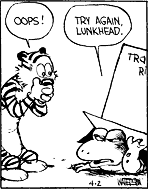
Calvin and Hobbes often played with a cardboard box labeled 'Transmogrifier'. While Calvin advertised it as able to 'turn you into anything at all', the dictionary gives us a different spin:  "To change or alter greatly and often with grotesque or humorous effect."

Technology Implications

In the context of technology, we run the risk of  'transmogrifying', unless we invest in architecting adaptable solutions that are equipped for:  

  • Complexity in the Middle: Plan for dynamic interactions, across a variety of connections, and a wide array of gadgets.
  • (Perceived) Simplicity at the Edge:  Expect users to demand stable, easy to use solutions that translate across devices (phone, tablet, PC, etc.)

Fortunately, tools are available, and improving.  Things like cloud services, service oriented architectures, and standards give us the building blocks to create dynamic, adaptable solutions, as long as we invest (time, people, dollars) to architect them.

Choose to Transfigure

Transfigure is defined as "transform outwardly and usually for the better".
      "For the better" or "with grotesque or humorous effect"
Not much of a choice when you put it that way.

What challenges do you face in architecting dynamic, adaptable solutions?


Wednesday, November 21, 2012

Move Slow to Move Fast

One of my former bosses used this phrase frequently.  It applies to many topics, but I'll focus on two in particular.  While they require you to 'slow down' with up front investments, they will streamline future efforts.

Portfolio Management:
Invest in tools, labor, and processes to create and maintain an IT portfolio (e.g., physical IT assets, facilities, software, skills, etc.). By leveraging you portfolio, you will:

  • Estimate projects more quickly and accurately
  • Identify efficiency opportunities 
  • Clarify risks (especially cyber / security risks)
  • Build stronger budget requests
  • Enhance IT team credibility 

NOTE: Pace your investment wisely, starting with  assets closely linked to your underlying costs.  Typically, workstations and software will be your biggest items.

Project Profiles:
IT teams struggle between two extremes:  "Never be Slow" and "Never be Over Budget"

I recommend you have your best project managers collaborate to develop project profiles that enable all project managers to pick the right approach based on key factors such as cost, risk, interface complexity, and expected benefits.  Each profile should address key items including:

  • What does the basic project plan look like (e.g., high level phases, tasks, etc.)?
  • How much can they spend without higher level approvals?
  • How many other teams need be involved (e.g., Do they need a full time security expert?)?
  • What level of testing is required?
  • Are there any special regulatory considerations (e.g., Sarbanes Oxley)?
What are your suggestions  for 'Moving Slow to Move Fast'?